Bunbury residents thinking about selling an old car to WA Fast Car Removal often focus on the beginning of the process — the call, the offer, the pickup. What most don’t think about is what happens after the vehicle leaves their Bunbury property, and how that journey is directly connected to the cash they receive. Understanding the lifecycle of a recycled Bunbury vehicle answers both curiosity and a practical question: where does the money actually come from?
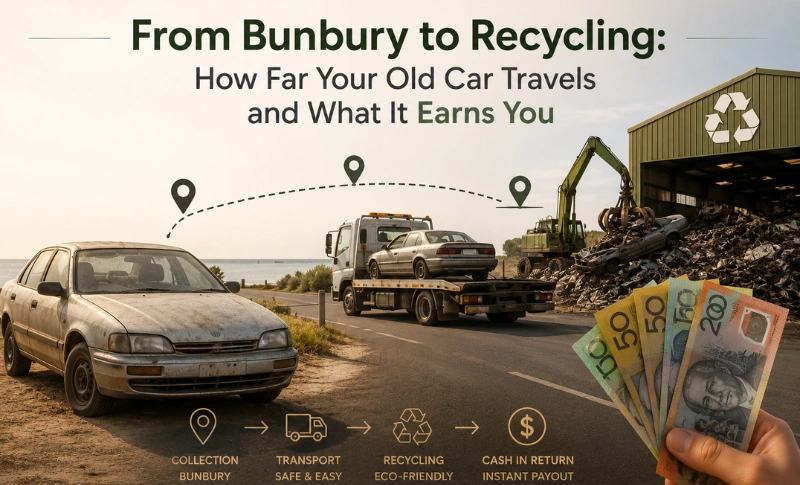
WA Fast Car Removal pays up to $9,999 for vehicles across car removal in Bunbury — and every dollar of that offer is traceable to a specific stage of the vehicle’s post-collection journey. This guide traces that journey from the moment our team loads your old car in Bunbury, through every stage of dismantling and recycling, to the materials market where it ends up.
Stage 1: The Collection — Your Driveway in Bunbury
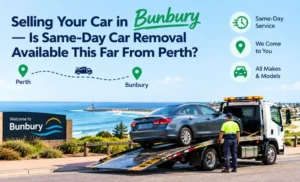
The journey begins at your Bunbury property. For most Bunbury sellers, the collection happens within 24–48 hours of the initial call — though WA’s regional scheduling means some flexibility is needed compared to Perth metro timelines, and we discuss this openly before you commit to anything.
Our team arrives at your Bunbury property with a truck equipped for all vehicle types — running and non-running. The transfer of vehicle licence paperwork is completed at your property, cash is paid before the vehicle is loaded, and the car is secured on the truck. From the moment you sign the paperwork, the car is no longer legally yours, and its journey begins.
For Bunbury vehicles specifically, the collection serves as the first step in a chain that connects WA’s South West to the broader Australian materials economy. Your old cash for unwanted cars — whether it’s a coastal ute, a family wagon, or an old work vehicle — contains materials that will serve productive purposes long after it’s left your property.
Important Read: Unwanted Car Removal Perth: What Makes Your Old Vehicle Worth Money
Stage 2: The Journey — Bunbury to the Processing Facility
After collection from your Bunbury property, the vehicle travels to a processing and dismantling facility. The distance and direction depend on facility locations and logistics — but the important point for Bunbury sellers is that this transport is entirely our responsibility and cost, never deducted from your offer.
During transit, the vehicle is secured on the truck. No further deterioration occurs — the journey is a protected transition between your property and the next stage of the vehicle’s life.
Stage 3: Fluid Draining — Environmental Compliance
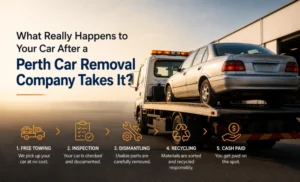
The first step at the processing facility is fluid drainage. Every vehicle — regardless of its condition, age, or the damage it has sustained — undergoes safe and compliant fluid removal before any dismantling occurs. This includes:
- Engine oil. Drained, collected, and sent for re-refining or responsible disposal in compliance with WA’s environmental protection requirements.
- Coolant. Drained and processed. Coolant contains ethylene glycol, which is harmful to waterways and must be handled carefully.
- Brake fluid. A hygroscopic fluid that absorbs moisture and must be disposed of as hazardous waste.
- Transmission fluid. Drained and processed from gearboxes and differentials.
- Power steering fluid and hydraulic fluid. Where applicable, drained before any dismantling of related systems.
- Air conditioning refrigerant. A controlled substance requiring certified equipment and handling for safe recovery.
- Fuel tank contents. Any remaining fuel is safely drained and managed.
This stage is non-negotiable and non-negotiated — it happens before any parts are touched or any metal is moved. For Bunbury sellers, knowing that your old car is handled responsibly after collection is part of the reason that professional car removal is the environmentally sound choice over simply abandoning a vehicle on a property.
Stage 4: Parts Assessment and Salvage
After fluid drainage, our car wreckers team conducts a systematic assessment of every recoverable component in the vehicle. This is the stage that most directly determines how much value is extracted from your Bunbury car — and how much of that value was reflected in the cash offer you received.
The assessment is methodical:
High-Value Mechanical Components
The gearbox, differential, alternator, starter motor, power steering pump, and other mechanical components are assessed first. Working components from popular makes — Toyota, Ford, Holden, Mazda, Mitsubishi — are removed, cleaned, tested where possible, and catalogued for Perth’s second-hand parts market. A functional gearbox from a Bunbury vehicle with a blown engine can be worth a meaningful sum as a standalone part.
The Catalytic Converter
Removed and assessed separately. The catalytic converter’s precious metal content — platinum, palladium, and rhodium — is the most valuable per-kilogram element of any standard vehicle. Its content is analysed, and its value is sent for precious metal recovery through specialised processors. The catalytic converter from a Bunbury vehicle contributes to the global precious metals supply chain.
Body Panels, Glass, and Interior
Straight, rust-free panels from Bunbury vehicles — doors, bonnets, boot lids, guards — are assessed for second-hand demand. Intact glass (windscreens, rear windows, side glass) is similarly evaluated. Interior components — seats, dashboards, trim — from popular makes are catalogued for Perth’s used parts market if in usable condition.
Important Read: Auto Removal Midland: Complete Checklist – What to Prepare Before Your Car Gets Picked Up
Tyres and Wheels
Legal tyres on alloy wheels are assessed for resale. Perished, damaged, or non-legal tyres go to the tyre recycling stream — where they’re processed into crumb rubber for use in road construction, playground surfaces, and other applications.
Stage 5: Metal Separation and Preparation
After all salvageable components have been removed, what remains is the vehicle’s metal shell — the body structure, chassis, remaining mechanical housings, and all fixed metal components. This stage involves separating metals by type for efficient recycling:
Ferrous Metal (Steel and Iron)
The bulk of the remaining vehicle — the body structure, chassis rails, subframe, and engine block — is predominantly ferrous metal. This is compressed into a bale or shredded into fragments for efficient transport. Ferrous scrap from Bunbury vehicles enters the steel recycling supply chain, where it’s melted and reformed into new steel products.
Aluminium Separation
Aluminium components — engine blocks in many modern vehicles, wheels, body panels, transmission housings — are separated from ferrous scrap because aluminium has a significantly higher per-kilogram value and a different melting and processing requirement. Aluminium from WA vehicles ultimately re-enters manufacturing supply chains as recycled aluminium.
Copper Recovery
The wiring harness — the copper electrical network that runs through every vehicle — is separated and sent to copper recycling. Copper’s high commodity value and energy-efficient recycling properties make it one of the most economically and environmentally valuable recoverable materials in any end-of-life vehicle.
Stage 6: Metal Processing and Market
The separated metals — ferrous, aluminium, and copper — travel to processors and ultimately to commodity markets where they’re traded and sold to manufacturers. This is the stage that connects a Bunbury old car directly to global materials markets, and where the commodity price movements that influence your cash offer originate.
In 2026, with strong demand from infrastructure and manufacturing sectors and a weaker Australian dollar making local scrap relatively attractive to export markets, the metals recovered from Bunbury vehicles are entering commodity markets at a favourable moment for sellers.
What This Journey Means for the Cash You Receive
The cash offer for your Bunbury vehicle reflects every stage of this journey in advance. WA Fast Car Removal’s assessment calculates:
- Parts value: Based on which components are salvageable, their current second-hand demand in Perth’s market, and the prices those components command.
- Precious metal value: The catalytic converter’s platinum-group metal content at current spot prices.
- Scrap metal base value: The vehicle’s estimated recoverable metal weight multiplied by current commodity prices, minus processing and logistics costs.
The offer you receive on the phone is the net of all these elements — what the vehicle’s journey through recycling will produce, paid to you upfront before the journey begins.
Why Selling Through WA Fast Car Removal Is the Responsible Choice for Bunbury
Bunbury’s coastal environment — the Leschenault Inlet, Geographe Bay, the estuary system — means that responsible vehicle disposal genuinely matters locally. Abandoned vehicles, DIY disposal, and vehicles left to deteriorate on Bunbury properties all create environmental risks — fluid leaks, tyre deterioration, and metal corrosion that can affect soil and groundwater.
Professional car removal from Bunbury through WA Fast Car Removal ensures that every fluid is safely captured, every recyclable material is properly processed, and nothing goes to landfill unnecessarily. The responsible disposal of your old car is part of what you’re paying for when you accept a cash offer — and it happens completely at our cost, not yours.
Frequently Asked Questions — Car Removal Bunbury
How does car removal work in Bunbury?
Call 0452 665 334 and describe your vehicle. Receive a firm cash offer within minutes. If you accept, we schedule a Bunbury pickup — typically within 1–2 days of your first call. Our team travels to Bunbury, completes all transfer of vehicle licence paperwork at your property, and pays cash before loading. The vehicle’s journey through dismantling and recycling happens entirely after that.
How quickly can a car be collected from Bunbury?
Bunbury pickups are typically scheduled within 1–2 days of the first call. We’ll confirm the timing clearly before you commit to anything and travel to Bunbury as promptly as possible once the offer is accepted.
Is car removal free from Bunbury?
Towing is included. For Bunbury and South West regional pickups, we discuss any travel logistics transparently before you commit — there are no surprise deductions from your cash offer on the day.
What types of vehicles can be removed from Bunbury?
All types — passenger cars, utes, vans, 4WDs, trucks. Old, damaged, running, non-running, registered or unregistered. South West coastal vehicles, high-mileage work vehicles, and estate cars are all regularly collected from Bunbury properties.
What happens to my car after it’s collected from Bunbury?
Your Bunbury car goes through a structured recycling process: fluid drainage, parts assessment and salvage, catalytic converter precious metal recovery, metal separation, and commodity market processing. Every recoverable material is responsibly handled. The value generated by this process is what produces your cash offer.
How much can I get for a car from Bunbury in 2026?
WA Fast Car Removal pays up to $9,999 for vehicles in Bunbury. The amount depends on the make, model, weight, condition, and current market rates for parts, precious metals, and scrap. 2026 conditions are strong for Bunbury sellers. Call 0452 665 334 for a free, firm quote.
Your Bunbury Car’s Journey Starts With One Call
From your Bunbury driveway to fluids safely drained, parts salvaged and resold, metals separated and recycled, and precious metals recovered — your old car has a productive journey ahead of it. WA Fast Car Removal connects you to that journey’s value upfront, with a firm cash offer and free collection from Bunbury.
Call 0452 665 334 now for your free, no-obligation quote. Our car removal Bunbury service is available 6 am–8 pm, seven days a week, and we travel to Bunbury and the South West regularly.